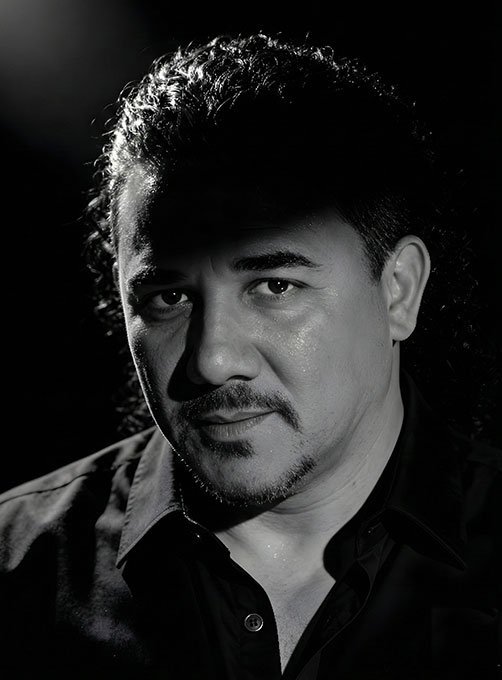
Fermin Fleites BIOGRAPHY
The Participant Observer: A Biography of Fermin Fleites
The Artist as Anthropologist
To define Fermin Fleites merely as a sculptor and draftsman would be to overlook the essence of his life’s project: a career conceived as a form of anthropological and philosophical inquiry.
Fleites’ trajectory constitutes a continuous journey: geographic, intellectual, and spiritual. It originates in the rich syncretic culture of his native Cuba, traverses a defining immersion in the Peruvian Amazon, and culminates in his current role as a chronicler of universal human narratives. His work is not simply an aesthetic product, but a field archive: a visual testimony to the complex and often contradictory human condition.
To understand the totality of his production, one must analyze the conceptual framework he has constructed, a theoretical scaffolding that supports every piece and project. At the center of this framework lies the perspective of the “Participant Observer,” a methodology adopted during his childhood in Cienfuegos, where he learned to analyze how popular culture generates its own narratives.
From this foundation, Fleites develops his own philosophical concepts, such as the neologism “ETERNITUDE,” which he defines as “a mixture of virtue and eternity. It’s not just about being eternal; it is about recognizing our place in the continuum of human endeavor.” This approach is complemented by a profound respect for techne, which in his own list means bronze, photography, wood sculpture, charcoal and mixed media. He draws everything, “perhaps inspired by the Andean shamans who resist being photographed because it stops them.” Finally, his work is articulated through the metaphor of the labyrinth, a model for understanding how seemingly disparate human stories intertwine in a perpetual cycle, inviting the viewer to actively participate in decoding their meaning.
The deliberate construction of this artistic identity, which fuses the roles of artist and anthropologist, is not a casual influence, but the fundamental methodology governing his entire production. Fleites not only describes himself through the lens of Cultural Anthropology, but he also earned a master’s degree in Media and Cultural Anthropology at the University of Havana (2003), a commitment evidencing dedication far beyond simple artistic interest. This synthesis allows him to position his work as a “journey of discovery,” transforming the viewer’s experience from mere aesthetic contemplation to an intellectual and spiritual exploration. In this way, his art transcends the object to become evidence, and his role evolves from creator to interpreter of humanity’s great narratives.
Part I. Forging a Worldview: Origins in Cienfuegos
The genesis of Fermin Fleites’ artistic vision is inextricably linked to his origins. He was born “in the heart of the Caribbean in Rural Cuba” and raised in Cienfuegos, where his early years unfolded in an atmosphere of profound dualities that would indelibly mark his future practice.
On one hand, there was the sociopolitical context of an island “dominated by totalitarian control.” This ideological reality contrasted radically with the vibrant and complex cultural fabric that surrounded him in daily life.
It was in this second realm, that of popular culture, where Fleites found the true raw material of his vocation. He grew up immersed in a syncretic milieu, among the common people, Abakuás, Christians and Santeros: a crucible of beliefs and practices that configured his fundamental perspective as a “Participant Observer.” From an early age, he paid close attention to how popular culture imbibed various influences to create its own narratives.
His first formal steps in art began at the age of ten in a vocational arts school, a place “where only those who echoed the praise of the state were acclaimed.” This early tension between official culture and popular belief became the foundational element of his artistic quest.
SPECIAL WITH NATALIA BOLÍVAR ARÓSTEGUI
Fleites’ entire oeuvre can be understood as the development of a fundamental dialectic born in his youth: the conflict between monolithic, state-sanctioned ideology and the fluid, syncretic, and often subversive narratives of popular culture. He himself describes his birth on an island under “totalitarian control” and his education in a school “where only those who echoed the praise of the state were acclaimed.” This constitutes the thesis of official culture. Simultaneously, he identifies his key formative influence in the common people, Abakuás, Christians and Santeros, who “ended up shaping” his “Participant Observer” perspective while he paid attention to how “popular culture was impregnated and created its own narratives.” This establishes the antithesis of lived, popular culture.
Consequently, his entire subsequent career, centered on anthropology, myth, and universal symbols, can be interpreted as the synthesis of this initial conflict: a lifelong project dedicated to exploring, documenting, and giving shape to these powerful non-official narratives that thrive beneath the surface of official histories. His work thus becomes a search for the universal truths residing in the collective imaginary.
Part II. The Academic Crucible: Art and Anthropology in Havana
Following his formative years in Cienfuegos, Fermin Fleites’ trajectory led him to the academic and artistic epicenter of Cuba. His education progressed “between drums, ñañigos and stage dramas,” an environment that propelled him toward the Instituto Superior de Arte (ISA) in Havana. There, he lived through the “heyday of the artistic academy in Cuba in the late 90’s,” a period of creative effervescence during which he managed to “perfect the visual language” of his work, endowing it with the technical and conceptual solidity that characterizes it.
However, the most decisive step of this stage was not limited to the field of visual arts. Parallel to his training at ISA, Fleites undertook an interdisciplinary leap that would prove fundamental to his career: he immersed himself deeply in Cultural Anthropology, eventually obtaining a master’s degree in Media and Cultural Anthropology from the University of Havana (2003). The move was more than a complement to his artistic practice. It gave his cultural observations, cultivated since childhood, a rigorous theoretical framework. Anthropology provided the analytical tools to structure and deepen his worldview, transforming intuition into methodology.
The fusion of these two disciplines bore tangible and significant fruit even before the degree did. Fleites directly attributes his success in securing his first major exhibition to this “mix of Visual Arts and Cultural Anthropology”: the show “Maferefun New York,” presented at The Metropolitan Pavilion in New York City. This event not only placed his work in one of the nerve centers of the global art world but also served as the gateway for his next ambitious project, “Del Periplo Camino de las Velas” (On the Periplus).
His studies in Cultural Anthropology, pursued until he obtained the master’s degree in Media and Cultural Anthropology in 2003, were the catalyst that transformed Fleites’ intuitive and observational interest in culture into a structured and analytical methodology. While his childhood observations had conferred upon him the perspective of a “Participant Observer,” his academic immersion in the discipline represented the transition from a personal stance to a formal discipline. The causal connection he establishes is unequivocal: “Thanks to this mix of Visual Arts and Cultural Anthropology I managed to get to my first major exhibition.” This demonstrates that his anthropological training was not a secondary interest, but the key to the next stage of his career.
SPECIAL ON AFRO-AMERICAN PRACTICES
Part III. The Journey into the Labyrinth: The Amazonian Immersion
The “Maferefun New York” exhibition acted as a threshold toward the most transformative phase of Fermin Fleites’ career: a “deep immersion in the Peruvian Amazon that lasted more than four years.” This period was not a simple artistic residency, but a field test where he definitively put his “anthropological vision and artistic skills” to the proof. It was in the density of the jungle where his studies took shape, “not only as academic exercises but as experiences of interaction with real human groups.” During those years he came to know Indigenous communities in the Paucartambo and Kosñipata area, as well as human groups in the Peruvian Amazon.
From this immersion came the works of “Del Periplo Camino de las Velas,” a series documenting and reinterpreting this experience. Much of this series consists of charcoal drawings, a medium Fleites privileges for its visceral connection to the primordial act of recording reality. These works, which are now part of important institutional and private collections such as the Center for Cuban Studies and the Museo de la Nación in Peru, stand as testimony to a journey that was as much physical as it was interior.
In Lima, he also exhibited at the Praxis Art Gallery, where his work was acclaimed by art critic Élida Román, who found it intelligent and full of ambition and praised his great capacity to integrate anthropology, psychology, history, and ethnography. Among the works she singled out were the mural “Yo y el otro” (I and the other) and the piece “Doscientas treinta y tres horas para…” (Two hundred thirty-three hours for…), created with organic pigments, gunpowder, and charcoal.
Drawing is not a mere stylistic preference for Fleites, but a pillar of his respect for techne and his anthropological approach. He repeatedly mentions his “habit of drawing everything” and links it, with a careful “perhaps,” to the “Andean shamans who resist being photographed because it stops them.” In the communities he has engaged with, he notes, people prefer to have their essence captured through drawing rather than photography, which seems to freeze them in time. The fact that his main project from this era, “Del Periplo,” is composed largely of charcoal drawings is no coincidence. It suggests that his four-year immersion was not just about observing others, but about absorbing their worldview regarding representation itself. This transforms his work as a draftsman into an exercise of anthropological empathy, an attempt to see and represent the world not only through his own eyes but also through the eyes of those he observes.
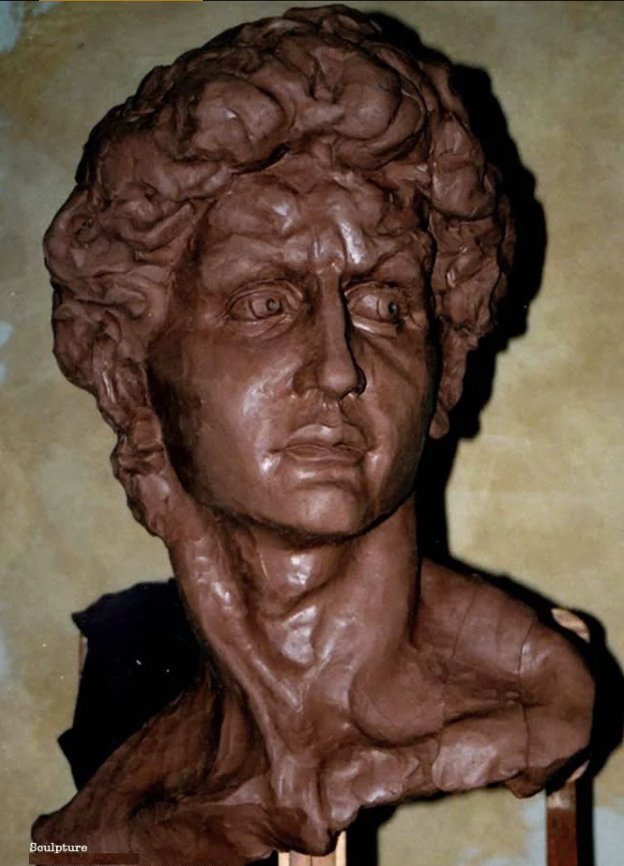

Part IV. The Syncretic Vision: Main Themes and Artistic Philosophy
Fermin Fleites’ work articulates around a set of recurring philosophical and thematic concepts that, together, define his worldview. These principles are not mere intellectual ornaments, but the conceptual engine driving his artistic production in drawing, sculpture, and installation.
The Labyrinth of Intertwined Stories. One of the most powerful and persistent metaphors in Fleites’ discourse is that of the labyrinth. For him, human history is not a linear progression, but a complex framework where “the same stories are recovered again and again and intertwined.” In his vision, this is a world where thousands of people invoke the same God by different names or share the same fundamental concerns as the ancient inhabitants of Ethiopia. His art functions as a map of this cultural labyrinth, challenging the viewer to active participation. It offers no simple answers; to understand the work, he writes, “you will have to take hold of your own ball and enter the labyrinth,” which suggests that meaning is constructed through interaction and personal introspection.
“ETERNITUDE”: The Continuum of Human Endeavor. To encapsulate his philosophy on time and culture, Fleites coined the neologism “ETERNITUDE,” which he defines as “a mixture of virtue and eternity. It’s not just about being eternal; it is about recognizing our place in the continuum of human endeavor.” In the same passage, he sees culture “as a living entity, with its own fears, dreams, and a huge ego,” and calls his work “an invitation to see ourselves as part of this eternal flow.” Close to it stands another of his images, an original time “where the past and the future are just nuances of a continuous present that is nowhere.” This idea rejects linear notions of progress and instead posits a fundamentally immutable human condition, where contemporary man, despite training artificial intelligences, remains in essence “that same human who asked the Sun for better harvests.”
“Ordered Chaos”: A Synthesis of Styles. Fleites’ primary visual strategy for representing the syncretic nature of culture is what critic Élida Román has termed “ordered chaos.” This is his notable ability to fuse seemingly disparate visual languages into a coherent and meaningful whole. In her words, his styles “make us jump from classical Greek and German Renaissance images to the most contemporary art forms, such as installations or conceptual art.” This method is not an arbitrary pastiche, but a deliberate reflection of how cultures absorb and reinterpret symbols, rituals, and beliefs over time, creating new realities from fragments of the past.
Art from Data. Fleites has also developed a methodology to create art from data analysis. In the mural commissioned for Bimini Big John’s Bar & Grill, his process integrates historical research and the study of local mythology with the quantitative analysis of social media trends and geolocated Google searches. By examining the topics people share on Facebook or search for online while physically on the island, Fleites accesses a form of contemporary collective imaginary. This approach allows him to create works that are not only rooted in the historical and cultural context of a place but also respond to the interests and consciousness of its current inhabitants and visitors, demonstrating an adaptation of ethnographic methods to the digital environment.
Fleites’ artistic evolution reveals a fascinating progression: from representing cultural syncretism to practicing methodological syncretism. It begins in the Cienfuegos of his childhood, among Abakuás, Christians and Santeros, where syncretism is something he observes; here, the theme is syncretic. Subsequently, his academic phase formally fuses Art and Anthropology, making his approach intrinsically syncretic. In his mature work, this fusion expands further. The “Harmony in Yellows” series, for example, integrates art with music through the study of cymatics. In his data-based art, the methodology itself becomes a complex syncretic act, combining traditional historical research, local mythology, and quantitative digital data. This journey demonstrates a coherent trajectory from observing a cultural phenomenon to embodying that same phenomenon in his own creative process.

Part V. A Chronology of Creation: Key Works and Series
Fermin Fleites’ philosophy materializes in a diverse body of work spanning sculpture, drawing, and conceptual projects. His most significant series and works reveal the consistent application of his anthropological principles and his exploration of universal symbols.
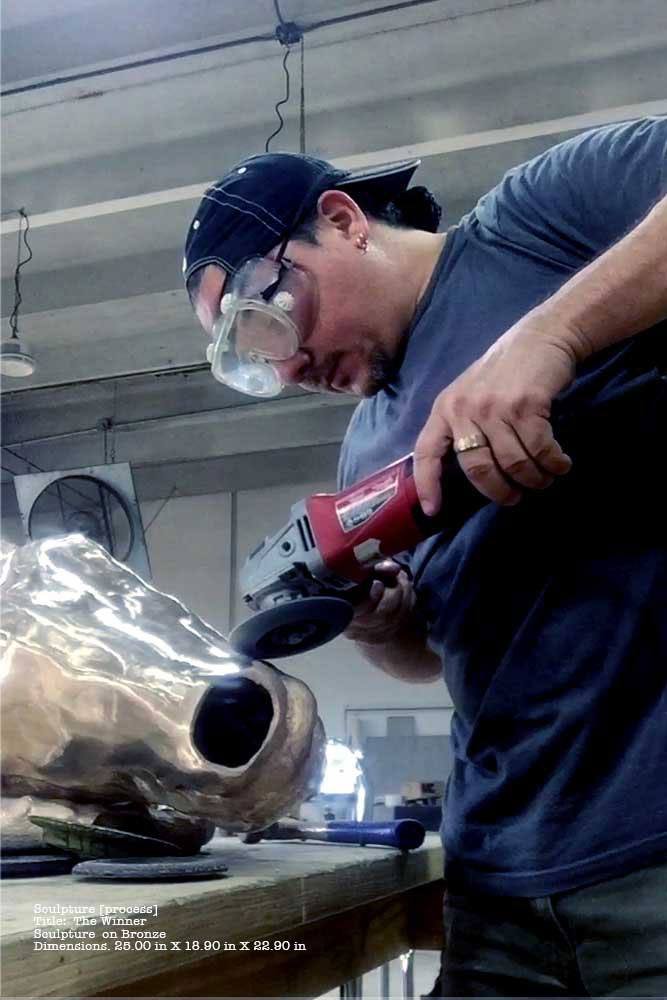
Foundational Symbols: “The Winner.” One of Fleites’ central pieces is the bronze sculpture “The Winner.” The piece is based on the figure of the Ram and “its founding character in the majority of cultural narratives, known to our species.” Fleites does not merely replicate the symbol; he perturbs and resignifies it. In his own words, the sculpture is “a re-creation of a key symbol of humanity’s great religions throughout history: a symbol that demarcates the birth of symbolic sacrifice, and simultaneously its disruption.” The sculpture’s base is equally significant: a fragment of a railroad tie from the railway Henry Flagler promoted on the route from New York to Havana, a line partially destroyed by the Labor Day Hurricane of 1935. This element anchors the work in a history of migration, ambition, and the fragility of great human constructions, becoming a powerful metaphor for the constancy of reinvention.
Narrative Drawings: “Story of a Fight against Demons.” This large-scale drawing, executed in charcoal on canvas, is a clear example of Fleites’ ability to create visual allegories of universal human conflicts. The work is inspired by the story of a town that decides to move its church to escape frequent demon attacks, without knowing that by moving it “they were carrying the demons with them, because they carried them inside.” This narrative serves as a direct metaphor for internal battles, for problems that cannot be evaded by changing location because they reside in the individual and collective psyche. Its exhibition during the Lima International Art Biennial enshrines it as one of his major works in the drawing medium, demonstrating his skill in addressing complex themes with an economy of means.
Conceptual Projects. Beyond individual pieces, Fleites develops conceptual series that carry an idea through several media.
- “The Three Marys” is a series of photographs presenting three mothers of radically different ages: 102, 33, and 13 years old. Through these images, Fleites visually illustrates the idea of life cycles, cycles that “open and close on themselves.” The series is a meditation on time, motherhood, and the stages of life, capturing distinct moments of the same female archetype.
- In “Diary of a Cunning Coward,” a series of drawings and bronze sculptures, the choice of media is fundamental to the concept. Drawing is selected for being “that first basic instinct of recording reality with charcoal,” connecting with the primordial origins of art. In contrast, bronze sculpture is chosen for its “desire to transcend time,” for its permanence and historical weight. The duality of the media reflects a tension between the ephemeral and the eternal, the instinctive and the enduring.
- “Harmony in Yellows,” a series of recent works, shows Fleites’ interest in the meeting of art, science, and the “unpredictable phenomena of nature.” The project draws on the field of cymatics, the study of how sound vibrations and waves can shape physical matter. Inspired by the frequencies of compositions by Debussy and Wagner performed on the cello, Fleites applies sound vibrations directly onto the canvas while the paint is fresh, generating “microuniverses” within the surface of the work. This series is not only an aesthetic exploration but also an investigation into harmony, interconnection, and the invisible forces that shape the world.

Part VI. The Artist in the Public Sphere
Fermin Fleites’ career has not been limited to the studio space; it has actively unfolded in the public sphere through exhibitions, collaborations, and a notable foray into mass media. His work has been presented in key galleries and museums, placing him in constant dialogue with both international contemporary art and the Cuban diaspora art scene.
Exhibition History and Critical Dialogue. Fleites’ first major exhibition, “Maferefun New York” at The Metropolitan Pavilion, was a decisive moment. The exhibition, devoted to African spirituality in Cuban art, gathered prominent Cuban artists such as Manuel Mendive, René Peña, and Zaida del Río, positioning Fleites’ work directly within the context of exploring African roots in Cuban art.
In Peru, he presented the acclaimed exhibition “Let me tell you…” at the Praxis Art Gallery in Lima. The critique by Élida Román, titled “An Artist to Follow,” praised his “great capacity to integrate the sources of artistic production of our days: anthropology, psychology, history and ethnography,” highlighting the work as “one of the best performances so far this year.”
Subsequently, established in the United States, Fleites has actively participated in exhibitions exploring the identity of the Cuban diaspora. In 2013, he was part of “African Roots / Raíces africanas” at the Cuban Art Space in Chelsea, New York, a show that brought together about 20 Cuban creators from various generations. In 2012, the year before, he took part in “Un Cortadito en Calle 8,” an exhibition of the CAFÉ project at Cremata Fine Art in Miami. These participations place him firmly within critical conversations about identity, migration, and Cuban-American culture.
Notable Collaborations and Media Presence. A collaboration of special relevance was his contribution to the sculptural group “Maelstrom” by the American artist Alice Aycock. This work was part of the public art project “Park Avenue Paper Chase,” installed on Park Avenue, New York.
Beyond the gallery world, Fleites has demonstrated a profound commitment to cultural dissemination through mass media. He has held a parallel and significant career in television, serving as Director, Scriptwriter, and General Producer of “Arte Mundo Latino” and demonstrating a creative versatility that complements his artistic practice. His work in this field shows his interest in communicating cultural ideas to a broader audience. Programs such as “Arte Mundo Latino” and “Masters of the Latin American Art” are a natural extension of his vocation as a researcher and cultural communicator, utilizing a mass medium to address the same questions of identity, art, and history that animate his drawings and sculptures.

The Ongoing Journey
The biography of Fermin Fleites is not that of an artist confined to a studio, but that of an explorer who has successfully and rigorously fused the roles of creator and ethnographer. His trajectory reveals a coherence of its own, a journey that starts from participant observation in the cultural crucible of Cuba, is tempered in the academic rigor of anthropology, is tested in the immensity of the Amazon, and projects today from Miami, where he lives and works, toward a global dialogue.
He has developed a visual and conceptual language to present, in his words, “a vision of Art, from the perspective of Cultural Anthropology, from the barbarism of Culture itself,” and to unravel the labyrinthine and universal nature of the human experience. His main contribution to contemporary art lies in this methodological synthesis. By integrating anthropology, history, mythology, and even digital data analysis into his creative process, Fleites has transcended the mere representation of cultural themes to embody syncretism in his own practice.
His work seeks not to offer definitive answers or close narratives; on the contrary, it functions as a portal, an invitation for the viewer to also become an explorer. Fermin Fleites’ journey is far from over. His work continues to evolve, incorporating new technologies and fields of knowledge, yet always anchored in the conviction that, beneath the surface of human differences, there is a common substrate of myths, fears, and yearnings. His work is a reminder that art, in its highest form, is not an object, but a participatory experience. By inviting viewers to enter his labyrinth of intertwined stories, he offers them the opportunity to be part of the continuous narrative that shapes and humanizes our world, converting his artistic journey into a perpetual act of discovery for both himself and his audience.
Copyright © ferminfleites.com. 2020 – 2026 All Right Reserved | Terms of Use | Privacy Policy
Designed with ❤️ in Miami by Digital Media 305